
Group transportation is one of the most misunderstood pieces of event planning. Most people assume it just means hiring a big bus, but the reality involves coordinated logistics, vehicle matching, timed itineraries, and safety protocols that can make or break your event. Whether you’re organizing a wedding, a corporate outing, or a wine tour, how you move your guests sets the tone for the entire experience. Group transportation means more than a vehicle booking. It’s a coordinated, safe, and efficient solution for moving 10 or more people with purpose and precision. This guide breaks down exactly what group transportation is, how it works, and how to get it right.
Table of Contents
- What is group transportation?
- How group transportation works: The step-by-step process
- Group transportation versus other options: Pros, cons, and costs
- Special considerations: Accessibility, urban settings, and event scaling
- What most guides miss about group transportation
- Plan your group transportation with expert support
- Frequently asked questions
Key Takeaways
| Point | Details |
|---|---|
| Definition clarified | Group transportation means coordinated travel for 10+ using vehicles like vans, minibuses, or coaches. |
| Major benefits | It offers cost savings, convenience, and reliability over individual or rideshare options for events. |
| Step-by-step planning | A systematic process ensures seamless event transport—start with headcount and book early. |
| Event-specific needs | Accessibility, urban environments, and group size changes demand special attention in planning. |
What is group transportation?
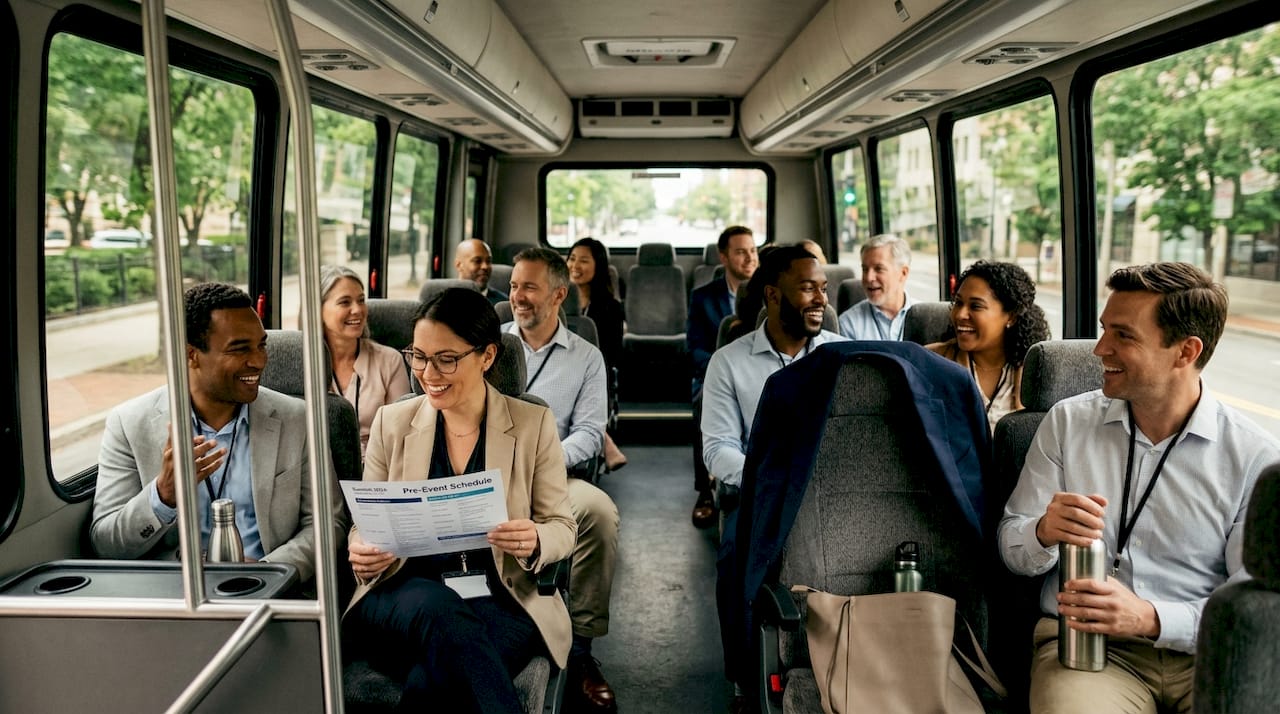
Group transportation refers to the organized, chartered movement of multiple people, typically 10 or more, using dedicated vehicles booked for a specific event or trip. Unlike public transit or individual rideshare, group transportation is coordinated around your schedule, your route, and your needs. It’s built for events like weddings, corporate outings, birthday parties, concert nights, wine tours, and private celebrations.
The vehicle options available are broader than most people realize. Vehicles scale from small VIP groups of 5 to 15 all the way up to large parties of 50 or more, using everything from sedans and sprinter vans to minibuses and motorcoaches. Here’s a quick look at how common vehicle types match up to different group sizes:
| Vehicle type | Typical capacity | Best for |
|---|---|---|
| Sedan / SUV | 4 to 12 people | Small VIP groups, airport transfers |
| Sprinter van | 8 to 15 people | Intimate events, wine tours |
| Minibus | 15 to 30 people | Mid-size events, corporate outings |
| Motorcoach | 40 to 56 people | Large weddings, conferences, tours |
| Party bus | 20 to 40 people | Celebrations, proms, nightlife events |
If you want to explore the full range of types of group vehicles available for events, there are options for virtually every group size and occasion.
The benefits of choosing dedicated group transportation go well beyond convenience:
- Togetherness: Everyone arrives at the same time, no stragglers
- Reliability: Professional drivers on fixed schedules reduce delays
- Cost efficiency: Per-person costs drop significantly for larger groups
- Safety: Licensed operators, insured vehicles, and trained drivers
- Reduced stress: No one has to navigate parking or coordinate carpools
“Group transportation takes the logistics headache off the event planner’s plate and puts the focus back where it belongs: on the experience itself.”
When your guests travel together, the event starts the moment they step on the vehicle. That’s a detail worth planning for.
How group transportation works: The step-by-step process
Knowing the basics is useful, but understanding how the process actually unfolds is what separates a smooth event from a chaotic one. Booking early, matching the vehicle to group size, creating clear itineraries, and using professional drivers are the pillars of a well-run group transport plan.
Here’s how a solid plan comes together:
- Assess your needs. Determine group size, travel distance, luggage requirements, and any accessibility considerations before reaching out to a provider.
- Book early. Aim to secure your vehicle at least one month before the event. Popular dates fill fast, especially around holidays and peak wedding season.
- Select your vehicle. Match the vehicle to your group size and the mood of the event. A sprinter van works for a small bachelorette group; a motorcoach is better for a 50-person corporate retreat.
- Build your itinerary. Map out every stop, pickup location, and drop-off time. The more detailed, the better.
- Add time buffers. Leave room between stops for delays, late arrivals, and unexpected holdups.
- Coordinate centrally. Use a shared manifest or booking platform so everyone knows the schedule. The driver needs a clear, confirmed plan.
- Execute on the day. The professional driver handles navigation and safety while your coordinator manages headcounts and timing on the ground.
Pro Tip: Always allocate at least a 20 to 35 minute buffer per major stop. Traffic, late guests, and venue delays are almost guaranteed. That buffer is not wasted time. It’s insurance.
For more detail on coordinating group bus rentals or on planning group transport for events, both resources break the process down even further for different event types.
Group transportation versus other options: Pros, cons, and costs
Group transportation is not always the obvious choice until you run the numbers and compare the experience. Here’s how it stacks up against rideshares and carpools.
| Feature | Group transportation | Rideshare | Carpool |
|---|---|---|---|
| Cost per person (10+ group) | Low to moderate | High | Very low |
| Reliability | High | Variable | Low |
| Arrival coordination | Guaranteed | Inconsistent | Inconsistent |
| Social experience | Excellent | None | Limited |
| Professional driver | Yes | Yes | No |
| Flexibility | Moderate | High | High |
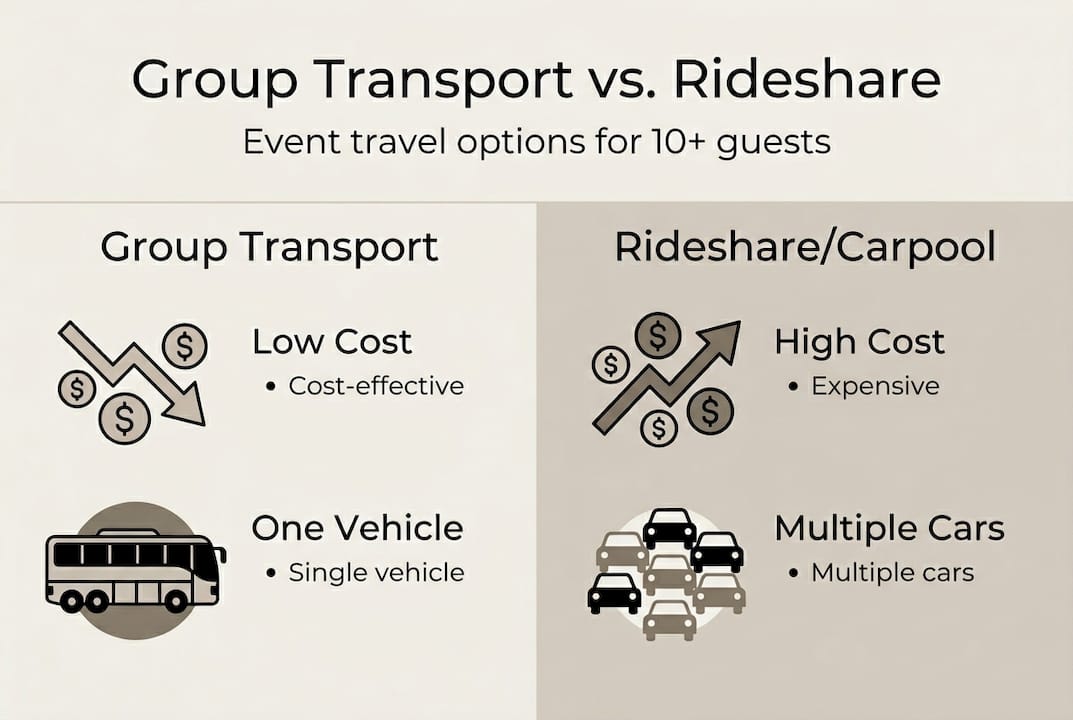
The cost case is compelling. Group transport saves 15 to 30 percent per person compared to rideshares for events with 10 or more travelers. On a group of 25 people, that adds up fast.
That said, group transportation is not the right fit for every situation. Here’s when each option makes the most sense:
- Group transportation: Best for 10 or more guests, fixed-route events, or occasions where everyone needs to arrive together
- Rideshare: Works for small last-minute additions or guests outside the main group pickup area
- Carpool: Suitable for very small informal gatherings where cost is the only concern and timing doesn’t matter
The main trade-off with group transportation is reduced flexibility. The route is set, the schedule is confirmed, and last-minute changes require communication with the provider. For events where coordination and guest experience matter, that structure is a strength, not a drawback.
If you’re weighing your options, it’s also worth reviewing event group safety standards as part of your decision. Not all transportation options carry the same insurance, licensing, and driver qualifications.
Special considerations: Accessibility, urban settings, and event scaling
Even a well-booked group transportation plan can run into trouble if you haven’t accounted for the edge cases. These are the details that separate good planning from great planning.
Accessibility is one of the most frequently overlooked areas. If any guests use wheelchairs, walkers, or have mobility challenges, you need to confirm ADA-compliant vehicles are available and book them early. These vehicles are in high demand and often require additional lead time. Urban areas require curb permits and extra time buffers; accessibility also means booking ADA vehicles well in advance to avoid last-minute scrambles.
Urban event logistics introduce a layer of complexity that suburban or rural events don’t face. City venues often have restricted loading zones, limited curb access, and unpredictable traffic patterns. You may need permits to stage a large coach in front of a downtown venue. Confirm these details with the venue and the transportation provider weeks ahead of time.
Here are some common edge cases and how to handle them:
- Guest count changes: Use a provider with a scalable fleet so you can shift from a minibus to a motorcoach if your headcount grows
- No-shows: Build a contingency plan so the bus doesn’t wait indefinitely. Set a firm departure time and communicate it clearly to all guests
- Last-minute additions: Confirm with your provider what the maximum vehicle capacity is and whether overflow vehicles are available
- Bad weather: Confirm the driver’s protocol for weather delays, especially for outdoor venues
- Venue access restrictions: Some venues have weight limits on driveways or narrow entry points that rule out larger coaches
Pro Tip: For any city event, prioritize a single, confirmed loading zone rather than splitting your group across multiple pickup points. Build in at least 20 extra minutes for traffic unpredictability. It sounds conservative, but city logistics will test that buffer every time.
For guidance on managing all of this compliantly, compliant group transport tips offers a practical breakdown specific to Northern California events and beyond.
What most guides miss about group transportation
Most group transportation guides focus entirely on the booking process, vehicle selection, and itinerary creation. That’s all important. But the real events go sideways not because of bad vehicles or wrong capacity choices. They fall apart because no one thought about what happens when things don’t go as planned.
The uncomfortable truth is this: even the best transport plan fails without real-time, on-the-ground adjustments. A professional driver can navigate traffic, but someone still needs to be managing the guest list, fielding late arrivals, and communicating with the venue. That person is your on-site coordinator, and most guides never mention them.
Contingency planning is not pessimism. It’s professionalism. What’s your plan if a guest misses the bus? What happens if the venue changes the load-in time the morning of the event? What if the motorcoach can’t fit in the parking structure? These are real scenarios.
When you work with licensed group transportation providers, the best ones will help you build contingency into the plan from day one. That’s not standard advice. It’s hard-won knowledge from running hundreds of events.
Plan your group transportation with expert support
Handling group transportation on your own is possible, but partnering with professionals removes the guesswork entirely. At Party Bus Broker, we connect event planners, couples, and corporate teams with licensed, insured transportation providers matched to their exact event needs.
Whether you need a sprinter van for a wine tour or a full motorcoach for a 50-person corporate event, we help you find the right fit fast. Browse shuttle services for group events to see available vehicle options, or learn how to coordinate your group event bus with step-by-step guidance from our team. We handle the details so you can focus on the event itself.
Frequently asked questions
How do you determine the right vehicle size for group transportation?
Match the vehicle to your group size and trip type. Vehicles range from sedans at 6 to 12 passengers up to motorcoaches at 40 to 56, with sprinter vans and minibuses covering the mid-range. When in doubt, size up slightly to allow comfort.
What events benefit most from group transportation?
Weddings, corporate outings, wine tours, parties, and conferences are the strongest fits, especially once your guest count hits 10 or more. Group transportation serves events like these by keeping everyone on schedule and creating a shared experience from the start.
How far in advance should you book group transportation?
Booking early, at least one month before your event date, is the standard recommendation, but peak seasons like summer and wedding season often require two to three months of lead time to guarantee your preferred vehicle.
What is the main advantage of group transportation over rideshare for events?
Beyond togetherness and reliability, the math is compelling. Group transport saves 15 to 30 percent per person compared to rideshares for groups of 10 or more, while also guaranteeing everyone arrives at the same place at the same time.
What should you do if group size changes last minute?
Communicate immediately with your provider. Scaling for changing sizes and having backup vehicles on standby are standard practices with professional fleet operators. Always confirm your provider’s policy on capacity adjustments before the event day.