When you’re responsible for moving 40 wedding guests or 200 conference attendees across town, the stakes are real. Buses are statistically safer than personal vehicles for group travel, but that safety advantage disappears the moment you hire an unvetted operator. Most event planners assume that any charter bus or shuttle with seats and a driver is good to go. That assumption is wrong, and it can expose you, your guests, and your organization to serious risk. This guide walks you through the regulatory framework, the vetting process, and the practical questions you need to ask before signing any group transportation contract.
Table of Contents
- Understanding safety regulations for group transportation
- Evaluating transportation providers: Credentials, inspections, and records
- Common risks and how providers address them
- Making safe group transportation choices for your event
- What most event planners miss about group transportation safety
- Plan safe transportation for your next event
- Frequently asked questions
Key Takeaways
| Point | Details |
|---|---|
| Know which vehicles are regulated | Buses, shuttles, and some vans used for compensation at events fall under specific federal safety standards. |
| Always verify operator safety | Check USDOT numbers, safety ratings, and driver credentials before booking any group transportation. |
| Look beyond compliance | Choose providers who exceed minimum standards with driver training, fatigue management, and emergency protocols. |
| Ask targeted questions | Engage carriers about inspection histories, safety programs, and backup plans to protect your group. |
Understanding safety regulations for group transportation
Not every vehicle that carries passengers is regulated the same way. Federal rules draw sharp lines based on vehicle capacity, whether the trip crosses state lines, and whether compensation is involved. Understanding those lines is the first step toward making a safe choice.
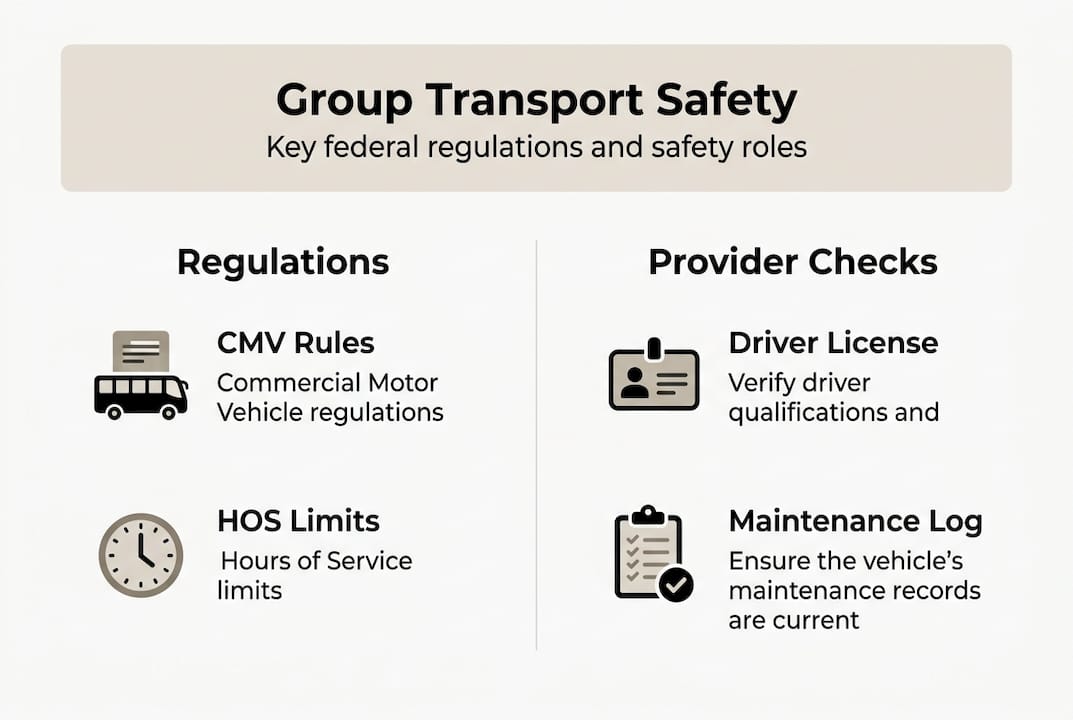
The Federal Motor Carrier Safety Administration (FMCSA) and the U.S. Department of Transportation (DOT) set the baseline rules for commercial passenger carriers. A passenger-carrying commercial motor vehicle (CMV) is generally defined as a vehicle designed to carry 16 or more passengers, including the driver. However, if a vehicle carries 9 to 15 passengers for compensation, it also falls under federal oversight. That means the sprinter van shuttling your VIP guests from the hotel to the venue may be just as regulated as a full-size motorcoach.
Here is a quick breakdown of how vehicle type affects regulatory status:
- Buses (16+ passengers including driver): Full FMCSA oversight, regardless of trip distance
- Vans or shuttles (9-15 passengers for pay): Regulated as CMVs under federal rules
- Private, uncompensated trips: Generally exempt from federal CMV rules
- Interstate vs. intrastate: Interstate trips (crossing state lines) trigger federal rules automatically; intrastate trips may follow state-specific rules, which vary widely
One distinction that catches many planners off guard is the difference between public transit and private charter. The Federal Transit Administration (FTA) has charter service regulations that actually restrict publicly funded transit agencies from competing with private charter operators for event work. That means if a city bus agency offers to handle your corporate shuttle, there are legal boundaries around what they can and cannot do.
| Vehicle type | Passenger count | Compensation required? | Federal CMV rules apply? |
|---|---|---|---|
| Motorcoach / charter bus | 16+ (incl. driver) | Yes or No | Yes |
| Sprinter van / shuttle | 9-15 | Yes | Yes |
| Sprinter van / shuttle | 9-15 | No | Generally No |
| Limousine (small) | Under 9 | Yes | Varies by state |
| Private vehicle | Any | No | No |
For shuttles and group transport compliance, always confirm the vehicle’s capacity and whether the trip is compensated before assuming which rules apply.
Evaluating transportation providers: Credentials, inspections, and records
Knowing the rules is one thing. Knowing how to verify that a specific operator follows them is another. The good news is that federal tools make this easier than most planners realize.
Every federally regulated carrier must have a USDOT number. You can look up any carrier’s safety record using the FMCSA SMS tool, which stands for Safety Measurement System. The SMS uses Compliance, Safety, Accountability (CSA) scores, called BASICs (Behavior Analysis and Safety Improvement Categories), to flag carriers with poor records in areas like unsafe driving, hours of service compliance, and vehicle maintenance.
Here is a step-by-step process for vetting any group transportation provider:
- Request the USDOT number from the carrier before any other conversation
- Look up their SMS/CSA scores at the FMCSA SMS website and check for any alerts
- Confirm the safety rating (Satisfactory, Conditional, or Unsatisfactory)
- Check for active out-of-service orders, which mean the carrier is legally prohibited from operating
- Verify driver credentials, including a valid Commercial Driver’s License (CDL) with a Passenger (P) endorsement
- Ask for proof of insurance that meets or exceeds federal minimums
- Request recent inspection reports to confirm vehicle maintenance is current
Driver credentials deserve special attention. A CDL with a P endorsement is required for drivers operating vehicles carrying 16 or more passengers. For verifying special event transport operators, confirming this endorsement is non-negotiable.
Pro Tip: When reviewing CSA scores, focus on the Unsafe Driving and Vehicle Maintenance BASIC categories first. These two are the strongest predictors of incident risk for event transportation.
For high-profile events where guest experience and safety are equally critical, look into VIP chauffeur vetting standards and ask whether drivers undergo background checks beyond the federal minimum. Some licensed chauffeur services go well beyond baseline requirements, and that extra layer of screening is worth asking about.
Common risks and how providers address them
Even a carrier with a clean record can create risk if they don’t actively manage the human and mechanical factors that cause incidents. Here are the most common risks and what good operators do about them.
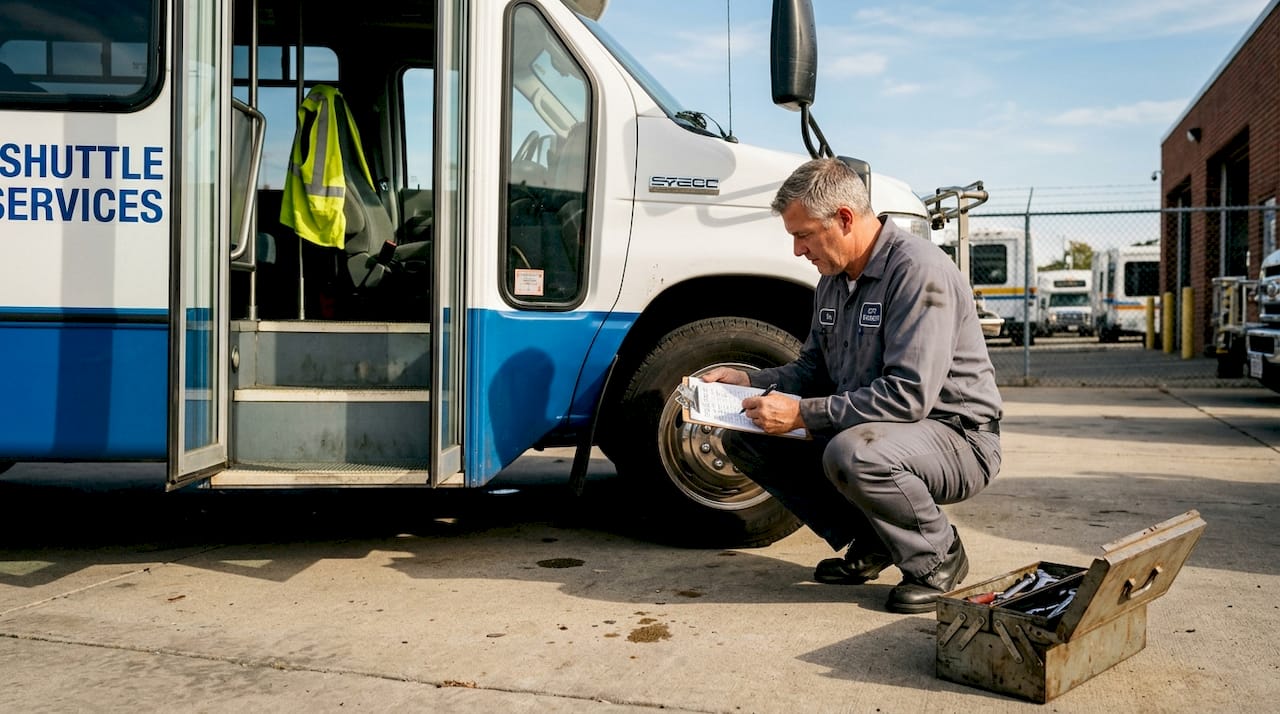
Driver fatigue is the single biggest concern. Federal HOS rules limit how many consecutive hours a driver can operate and require mandatory rest periods. For event transportation, this matters because late-night events, multi-stop wedding days, or back-to-back corporate shuttles can push drivers close to or beyond legal limits. Always ask whether your event’s schedule falls within the driver’s available hours.
Vehicle maintenance is the second major factor. Reputable operators keep detailed maintenance logs and schedule inspections more frequently than the federal minimum requires. Ask for the vehicle’s most recent inspection date and whether it passed without deficiencies.
Here is a comparison of minimum compliance versus best-practice standards:
| Safety factor | Federal minimum | Best-practice standard |
|---|---|---|
| Driver hours | 10-hour rest after 15-hour on-duty | Proactive scheduling with buffer time |
| Vehicle inspection | Annual federal inspection | Pre-trip and post-trip daily checks |
| Driver background check | MVR check at hire | Annual MVR plus criminal background |
| Insurance | $1.5M liability (large buses) | Higher limits with event-specific riders |
| GPS tracking | Not required | Real-time tracking with client access |
“Bus fatal crash rates are significantly lower than those for passenger cars, but human factors remain the primary concern in incidents that do occur.”
Smart operators also invest in real-time GPS tracking, onboard cameras, and emergency response protocols. These tools go beyond legal requirements and give you, as the event planner, a way to monitor trip progress and respond quickly if something changes.
Pro Tip: Ask your carrier whether their drivers are employees or independent contractors. Employee drivers are typically subject to more consistent training and oversight than contractors.
For events where SMS safety management and documentation are part of your planning process, make sure your transportation provider can supply written safety policies on request.
Making safe group transportation choices for your event
With a clear picture of regulations and risks, you can now build a practical vetting process that protects your guests and reduces your liability.
Start with this checklist when comparing providers:
- Confirm USDOT registration and active operating authority
- Review SMS/CSA scores for any flagged BASIC categories
- Verify driver CDL and P endorsement for vehicles over 15 passengers
- Request proof of current insurance with limits appropriate for your group size
- Ask for a maintenance log or most recent inspection certificate
- Confirm HOS compliance for your event’s specific timeline
- Get a written backup plan in case of vehicle breakdown or driver emergency
- Document everything in a signed contract that includes safety representations
Bus occupant fatalities represent a small fraction of all traffic fatalities, and professional drivers are a major reason why. Choosing a vetted operator with a strong safety record is the single most effective thing you can do to protect your group.
Pro Tip: Save all safety documentation from your transportation provider alongside your event contracts. If a liability question ever arises, your due diligence record is your best defense.
For leisure and wine tour safety or any event involving alcohol, confirm that your provider has experience managing those specific dynamics, including designated drop-off protocols and guest management policies. For flexible scheduling, hourly transport choices let you build in buffer time without locking into a rigid schedule that could pressure drivers.
What most event planners miss about group transportation safety
Here is an uncomfortable truth: most event planners who do their homework still stop too early. They check the USDOT number, confirm insurance, and move on. That covers the paperwork. It doesn’t cover the conversation.
The real gap in group transportation safety is engagement. The planners who avoid problems are the ones who call the carrier, ask specific questions about the driver assigned to their event, and request a pre-trip walkthrough. They treat the transportation provider as a partner, not a vendor.
Even smaller event vehicles can fall into regulated CMV territory and carry overlooked risks. A 12-passenger sprinter van for a corporate airport run is not automatically safer just because it’s smaller.
The best operators in this industry go well beyond legal minimums. Their drivers train more, rest more, and communicate better than the rules require. When you find a carrier like that, you’re not just buying a ride. You’re buying a safety culture. For group shuttles and safety at any scale, that culture is what separates a smooth event from a preventable incident.
Plan safe transportation for your next event
You now have the framework to evaluate any group transportation provider with confidence. Putting that knowledge to work is the next step.
At Party Bus Broker, every operator in our network is vetted for licensing, insurance, and safety compliance before we match them with a client. Whether you’re coordinating special event transportation for a 20-person wedding party or moving hundreds of attendees across a corporate campus, we match you with the right vehicle and the right operator. Explore our full range of group transportation and shuttle services or contact our team to discuss your event’s specific needs. Safe, reliable group transportation starts with one conversation.
Frequently asked questions
What is a passenger-carrying commercial motor vehicle (CMV)?
A passenger-carrying CMV is typically a bus, shuttle, or van designed to transport 16 or more people including the driver, or 9 to 15 passengers if operated for compensation, and is subject to federal safety regulations.
How can event planners check if a group transportation provider is safe?
You can verify a provider’s USDOT number and safety record using the FMCSA SMS website, and by confirming driver qualifications and recent inspection history before booking.
Are smaller vans or shuttles subject to the same regulations as buses?
If a van or shuttle seats 9 to 15 passengers and is operated for compensation, it is regulated as a CMV and must comply with federal safety rules, just like a full-size bus.
Why are hours-of-service (HOS) rules important for group transportation?
HOS rules prevent driver fatigue by limiting consecutive driving hours, and fatigue is one of the leading causes of bus crashes, making these rules essential for any event with a complex or late-night schedule.
What safety advantages do buses have over regular vehicles for events?
Buses have a lower fatal crash rate per mile traveled compared to passenger cars, and professional drivers with proper credentials and training contribute significantly to that safety record.
Recommended
- Group Transportation | Napa, CA | Shuttles Services
- Special Event Transport | Napa, CA | Party Bus Broker
- Napa, CA | Wine Tours & Leisure Rides | Party Bus Broker
- Limo & Chauffeur Services | San Francisco, CA | Party Bus
- Group transportation explained: efficient solutions for Toronto events
- Process for arranging event transportation: 90% on-time success