
Booking a bus for your next corporate outing or Napa wine tour seems straightforward until the vehicle gets pulled over, the driver fails a license check, and your entire event unravels before the first stop. Non-compliant group transportation is not just a vendor problem. It becomes your problem the moment you signed the contract. The CPUC issued fines between $4,000 and $20,000 to multiple carriers in 2025 for violations including missing permits and no Employer Pull Notice enrollment. As an event planner or corporate client in Northern California, understanding what compliance actually means is the single most important step you can take before any group booking.
Table of Contents
- Understanding compliance requirements for group transport in California
- Driver qualifications and safety protocols
- Insurance, workers’ compensation, and recordkeeping essentials
- Nuances: Edge cases, independent contractors, and public agency limitations
- A hard truth: Why shortcuts in compliance backfire every time
- Choosing a truly compliant group transport partner
- Frequently asked questions
Key Takeaways
| Point | Details |
|---|---|
| Verify compliance every time | Always confirm your group transport provider holds proper permits and insurance before booking. |
| Only use vetted drivers | Drivers must be EPN-enrolled, background-checked, and bound by legal hours of service. |
| Don’t risk shortcuts | Non-compliance brings costly fines, liabilities, and damaged reputations for events and organizations. |
| Understand special cases | Edge scenarios such as gig drivers and public transit require extra scrutiny to stay compliant. |
Understanding compliance requirements for group transport in California
Compliance in group transportation is not a vague concept. It is a specific set of legal permits, agency approvals, and inspection records that every provider operating in California must maintain. When you charter a party bus, charter coach, or sprinter van for a wedding in Sonoma or a corporate shuttle in Sacramento, the carrier must meet requirements set by multiple state and federal agencies.
The starting point is the TCP permit. Providers must obtain a TCP permit from the California Public Utilities Commission, known as the CPUC, before legally transporting paying passengers. TCP stands for Transportation Charter Party. You can verify a carrier’s permit status directly on the CPUC website. If a company cannot produce a valid TCP number, stop the conversation immediately.
Beyond the permit, vehicle safety is governed by the California Highway Patrol through its BIT program, which stands for Biennial Inspection of Terminals. Vehicles over 10,000 lbs must pass 90-day mechanical inspections under this program. Most party buses, charter coaches, and large sprinter vans exceed that weight threshold. These inspections cover brakes, tires, lighting, steering, and emissions. Carriers must keep inspection records on file and produce them on request.
For licensed group transportation covering events like wine tours, corporate retreats, or wedding day shuttles, the compliance picture involves several agencies working together.
Key agencies overseeing group transport compliance in California:
- CPUC (California Public Utilities Commission): Issues TCP permits, enforces charter rules, and levies fines for violations
- California Highway Patrol (CHP): Runs the BIT inspection program and roadside enforcement
- U.S. Department of Transportation (DOT): Governs interstate trips, drug and alcohol testing programs, and federal safety ratings
- California Department of Motor Vehicles (DMV): Handles commercial driver licensing and vehicle registration
| Requirement | Governing agency | What to verify |
|---|---|---|
| TCP permit | CPUC | Active permit number on CPUC lookup |
| 90-day vehicle inspection | CHP BIT program | Inspection sticker and maintenance logs |
| Commercial driver’s license | DMV | Valid CDL with correct endorsements |
| Federal safety rating | DOT/FMCSA | Satisfactory rating on SaferBus.com |
| Workers’ compensation | State of California | Current certificate of insurance |
For special event transportation like proms, concerts, or large corporate outings, these requirements apply regardless of trip length. Even a 20-minute shuttle between a hotel and a venue falls under CPUC jurisdiction if money changes hands.
Driver qualifications and safety protocols
Once permits and vehicle checks are covered, attention must shift to the people behind the wheel. A compliant vehicle with an unqualified driver is still a liability waiting to happen.

California law requires that drivers for commercial passenger carriers be enrolled in the Employer Pull Notice program, commonly called EPN. Drivers must be enrolled in the EPN program and pass background checks before operating any passenger vehicle commercially. The EPN program automatically notifies employers when a driver receives a traffic violation, a DUI, or any license action. It is an ongoing monitoring system, not a one-time check.
Background checks must cover criminal history, prior driving records across all states, and any prior employment terminations related to safety. A driver who passed a background check three years ago but received a DUI last year should not be behind the wheel of your group’s bus. The EPN program exists precisely to catch those gaps.
Hours of service rules also apply. Federal regulations limit commercial drivers to 10 hours of driving time and 16 hours of total on-duty time within any 24-hour period. For long wine tour days or multi-stop corporate events, this matters. A driver who started a shift at 6 a.m. for an airport pickup cannot legally drive your group home at midnight without a rest break. Carriers must keep hours-of-service logs, and you have every right to ask about them.
For safety standards for planners, here is what to confirm with any provider before signing:
- Valid CDL with passenger endorsement on file
- Active EPN enrollment confirmed in writing
- Background check completed within the last 12 months
- Hours-of-service logs available for review
- Drug and alcohol testing program in place (required for DOT-regulated carriers)
- Emergency contact and communication protocol for the event day
Pro Tip: Visit SaferBus.com and search the carrier’s DOT number before booking. You will see their safety rating, inspection history, and any out-of-service orders. A “Satisfactory” rating is what you want. “Conditional” or “Unsatisfactory” ratings are red flags that no discount should override.
For a full planning group transport checklist, building driver verification into your standard booking workflow protects you, your guests, and your professional reputation.
Insurance, workers’ compensation, and recordkeeping essentials
In addition to safe vehicles and drivers, the financial backbone of compliance is insurance and proper documentation. This is where many planners get caught off guard because a carrier can look legitimate on the surface while carrying inadequate coverage underneath.
California requires commercial passenger carriers to maintain minimum liability insurance based on vehicle capacity and trip type. For vehicles carrying more than 15 passengers, minimum coverage thresholds are significantly higher than for standard commercial vehicles. Always request a certificate of insurance, not just a verbal confirmation. The certificate should list your organization as an additional insured for the event date.
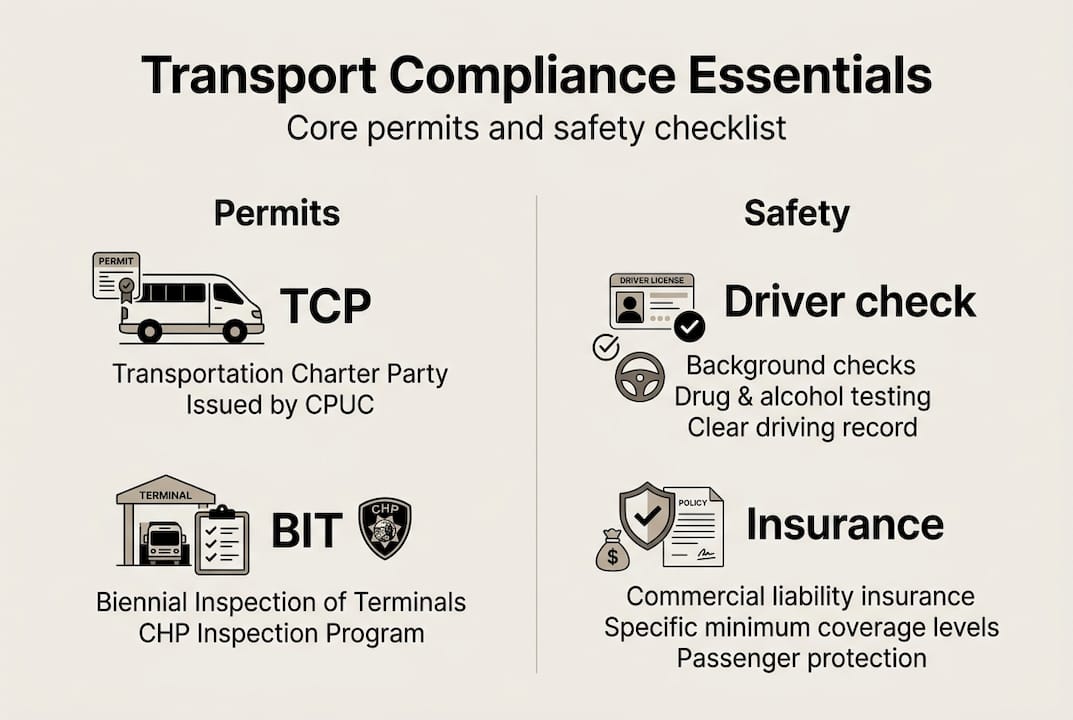
Common CPUC violations include operating without authority, no workers’ compensation, and incomplete records, with fines ranging from $4,000 to $20,000 per citation. Workers’ compensation is not optional. Any carrier with employees must carry it. If a driver is injured during your event and the carrier has no workers’ comp, your organization could face secondary liability claims.
Use this comparison to know what you are looking at when reviewing a carrier’s paperwork:
| Documentation item | Compliant carrier | Non-compliant carrier |
|---|---|---|
| Certificate of insurance | Current, lists coverage limits | Expired or unavailable |
| Workers’ comp certificate | Active policy on file | Missing or “contractor only” |
| TCP permit copy | Provided on request | Cannot produce |
| Inspection records | 90-day logs available | No records kept |
| Driver qualification file | Complete with CDL and EPN | Incomplete or verbal only |
Pro Tip: Ask the carrier to send insurance certificates directly from their insurance provider, not a copy forwarded through email. This simple step confirms the policy is real and current. Cross-check expiration dates against your event date. A policy that expires two days before your wedding is not coverage.
Review a fleet insurance checklist to understand exactly what line items to look for on a commercial transportation certificate before your event.
Nuances: Edge cases, independent contractors, and public agency limitations
Compliance gets trickier when group travel plans don’t fit the usual mold. Here’s what you need to know about the less-obvious scenarios.
Some event planners try to save money by piecing together transportation using gig drivers, subcontracted vehicles, or municipal shuttles. Each of these approaches carries specific legal risks that can expose you to liability even when the trip goes smoothly.
California’s ABC test governs whether a worker is an employee or an independent contractor. Independent contractor rules in transport generally follow Borello after ABC test exceptions are applied. In practice, most commercial passenger transport drivers must be classified as employees, not contractors. A carrier that uses “independent” drivers to avoid payroll taxes and workers’ comp is operating outside the law. If something goes wrong on your event, that misclassification becomes your exposure too.
Public transit is another gray area. Many planners assume a local transit agency can charter buses for a private corporate event or wedding. That is usually not the case.
“Federal Transit Administration charter rules restrict public transit agencies from competing with private charter operators. Exceptions exist only when no registered private operator is available to serve the trip.”
This means your city’s transit system cannot legally run a private shuttle for your corporate retreat if a licensed private carrier is available. Review FTA charter service regulations before assuming public options are viable.
Scenarios that trigger stricter compliance review include:
- Using a broker that sublets to unlicensed carriers
- Hiring a vehicle owner who drives their own bus as a “contractor”
- Booking intercity trips that cross state lines without DOT interstate authority
- Using a vehicle that seats more than 15 passengers without verifying federal motor carrier registration
- Assuming a municipal shuttle program covers private events
For coordinating event bus rentals that involve multiple stops, multiple vehicles, or unusual logistics, always confirm that every vehicle and every driver in the chain holds the correct credentials.
A hard truth: Why shortcuts in compliance backfire every time
Here is the perspective most articles skip: the real cost of non-compliance is not the fine. The fine is just the first bill.
When a carrier gets cited by the CPUC, the event planner who booked them often faces their own reckoning. Corporate clients pull vendor lists. Wedding venues share blacklists. A single incident with an uninsured or unlicensed carrier can end a planning business that took years to build. We have seen it happen.
The carriers who cut corners on TCP permits or workers’ comp are usually the same ones who skip vehicle maintenance and ignore hours-of-service rules. These are not isolated failures. They are symptoms of an operation that treats compliance as optional across the board.
Seasoned planners do not assume. They verify. Every booking, every time. A group transport safety guide used as a pre-booking checklist takes 20 minutes and can prevent months of legal fallout. The carriers who welcome that scrutiny are the ones worth hiring. The ones who resist it are telling you everything you need to know.
Pro Tip: Build a compliance verification step into your standard contract workflow. Require carriers to submit their TCP permit number, insurance certificate, and DOT safety rating before any deposit is processed. Make it non-negotiable.
Choosing a truly compliant group transport partner
If you want group transportation without compliance headaches, vetted options exist. Knowing what to look for is only half the battle. Finding carriers who already meet every standard is where the real time savings happen.
At Party Bus Broker, we work exclusively with licensed and insured transportation providers who meet California’s TCP, CHP, and DOT requirements. Our event transportation planning process includes carrier vetting at every step, so you are never guessing about permits or insurance. Whether you need a sprinter van for a Napa wine tour or a charter coach for a Sacramento corporate event, our transport safety standards are built into every booking. Explore our Napa shuttle services or reach out to discuss your event needs directly.
Frequently asked questions
What is a TCP permit and why does it matter for events?
A TCP permit is a legal authorization from the CPUC that every commercial group transport provider in California must hold. Without it, operating without authority exposes both the carrier and the event organizer to fines and liability.
How often must group transport vehicles be inspected?
Vehicles over 10,000 lbs must pass safety inspections every 90 days under the CHP BIT program, covering brakes, tires, lighting, and other critical systems.
Can event planners use independent contractors or gig drivers for group shuttles?
Rarely and carefully. California’s ABC test limits contractors in commercial passenger transport, meaning most group shuttle drivers must be classified as employees of a licensed carrier.
What are typical fines for group transport non-compliance?
The CPUC issues fines from $4,000 to $20,000 per citation for violations including operating without a TCP permit, missing workers’ compensation, and incomplete records.
Can public transit be used for private group charters or weddings?
Generally no. FTA charter rules restrict public transit agencies from competing with private charter operators, except in rare cases where no private provider is available.