Planning group transportation for an event sounds straightforward until you’re on a call with a vendor who keeps referencing “load-in windows,” “PAR systems,” and “room block attrition” while you’re nodding along and quietly panicking. Miscommunication around transportation terminology is one of the most common reasons events run late, budgets blow up, and guests end up stranded. This guide cuts through the jargon with plain-English definitions, real-world examples, and practical tips so you can walk into any vendor conversation with confidence and get your group where it needs to be, on time and without surprises.
Table of Contents
- Why event transportation terminology matters
- Core event transportation terms defined
- How transportation logistics work at live events
- Tips for clear communication with vendors and guests
- Our perspective: What most planners miss about transportation terms
- Effortless event transportation: Get it right every time
- Frequently asked questions
Key Takeaways
| Point | Details |
|---|---|
| Correct terms prevent errors | Using industry-standard transportation terminology eliminates misunderstandings with vendors and staff. |
| DMC and shuttles defined | A DMC coordinates local logistics and shuttle services ensure groups move efficiently between event points. |
| Apply terms in planning | Integrate terms like load-in, room block, and Park & Ride into contracts and event run sheets for clarity. |
| Proactive communication wins | Brief all vendors and guests in advance with clear definitions to reduce onsite confusion. |
Why event transportation terminology matters
Getting the language right is not just about sounding professional. It directly affects how your event runs. When a planner and a transportation vendor use the same word to mean two different things, the result is missed pickups, double-booked vehicles, and guests waiting outside a venue with no ride in sight. These are not hypothetical scenarios. They happen at real events, and they are almost always preventable.
Consider what happens when a planner asks for a “shuttle” without specifying the route, frequency, or capacity. One vendor might interpret that as a single round trip between a hotel and a venue. Another might assume a continuous loop running every 15 minutes. Without shared definitions, both parties sign a contract believing they have agreed on the same service. They have not.
Here are some of the most common terminology gaps that cause problems at events:
- Confusing a shuttle service with a charter bus, which affects pricing and scheduling
- Misunderstanding load-in timing, causing vehicles to arrive before venue access is granted
- Failing to define a DMC (Destination Management Company) role in the contract, leaving transportation coordination in limbo
- Overlooking Park & Ride logistics, which require separate staging areas and signage
As one industry resource explains, shuttle services involve moving large groups between hotels, venues, and airports for events. That sounds simple, but the operational details behind that sentence involve driver schedules, vehicle capacity, route timing, and guest communication. None of that happens automatically.
“The difference between a smooth event and a logistics nightmare often comes down to whether everyone in the room is working from the same definitions.”
Proper terminology also protects you legally. Vendor contracts that use vague or undefined terms leave room for disputes about what was actually promised. When you use precise language in your agreements, you create a paper trail that reflects the actual service you negotiated. Managing group transportation logistics becomes significantly easier when every stakeholder is aligned from the start.
Core event transportation terms defined
Let’s break down the terms you will encounter most often when planning group travel for events. These are the definitions that show up in contracts, vendor proposals, and event briefings.
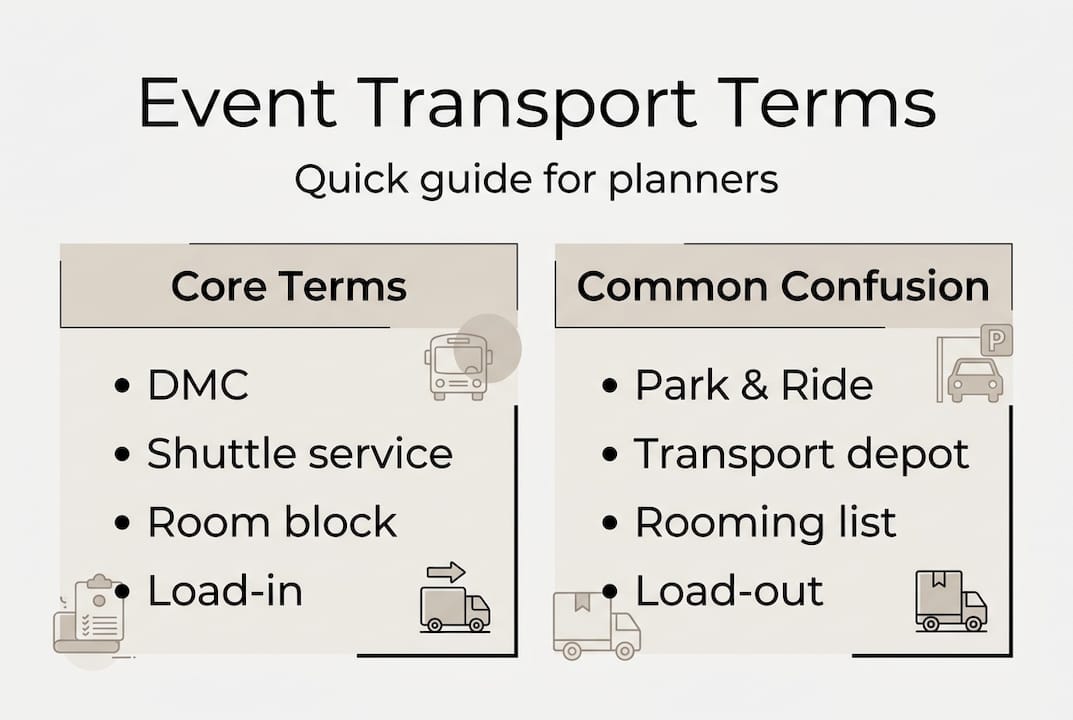
DMC (Destination Management Company): A DMC is a local expert providing logistical support including transportation for events. If you are planning an event in a city you are unfamiliar with, a DMC can coordinate everything from airport pickups to shuttle routes using their existing vendor relationships.
Shuttle Service: A dedicated vehicle or fleet that moves guests between two or more fixed points on a set schedule. Common for hotel-to-venue runs at conferences and weddings.
Guest Room Block: A reserved set of hotel rooms at a negotiated group rate. Closely tied to transportation because room block locations determine pickup points and travel distances.
Rooming List: A document listing guest names assigned to specific rooms within the block. Drivers and coordinators use this to verify pickups and manage VIP arrivals.
Load-In / Load-Out: The scheduled time window for vendors (including transportation providers) to access the venue before and after the event.
Park & Ride (PAR): A system where guests park at a remote lot and board shuttles to the venue. PAR and Spectator Transport Depots are logistics terms for managing large-scale event attendee transport, commonly used at festivals and sporting events.
Spectator Transport Depot (STD): A centralized staging area where guests board and exit event shuttles.
Here is a quick comparison of terms that often get confused:
| Term | What it means | Common confusion |
|---|---|---|
| Shuttle service | Fixed-route group transport | Mistaken for open charter |
| Charter bus | Exclusive vehicle for your group | Confused with shared shuttle |
| DMC | Local logistics coordinator | Confused with travel agency |
| Park & Ride | Remote parking plus shuttle | Confused with general parking |
| Load-in | Venue access for setup | Confused with guest arrival time |
For special event transport and airport transportation services, knowing these distinctions before you call a vendor will save you at least one round of back-and-forth emails.
Pro Tip: Before finalizing any transportation plan, ask your vendor for a terminology reference sheet. Many experienced operators have one ready. If they do not, that tells you something important about how they communicate.
How transportation logistics work at live events
Definitions are only half the story. Let’s see how these concepts play out on actual event days, because the gap between knowing a term and applying it correctly is where most planners get caught off guard.
Take a corporate conference with 400 attendees arriving from three different hotels. The planner needs to coordinate room blocks at each property, confirm pickup times with the shuttle provider, and build a load-in schedule that gets vehicles staged at the venue before the first guest arrives. Each of those steps depends on the planner and vendor using the same definitions.
Here is a practical sequence for managing group arrivals at a large event:
- Confirm room block locations and share the rooming list with your transportation coordinator at least 72 hours before the event.
- Set load-in windows with the venue to establish when vehicles can access the property for staging.
- Map shuttle routes between each hotel and the venue, factoring in traffic and travel time buffers.
- Designate a Spectator Transport Depot or staging area where guests board and exit vehicles.
- Schedule load-out times to begin after the event ends, with buffer time built in for delays.
As the event planner glossary notes, load-in and load-out are vendor setup and breakdown windows, not guest arrival times. Mixing these up is a surprisingly common mistake that results in vehicles blocking venue entrances or drivers waiting in the wrong location.
Here is a timing reference table for a typical evening event starting at 7:00 PM:
| Task | Recommended time | Key term involved |
|---|---|---|
| Venue access for transport | 3:00 PM | Load-in |
| First shuttle departure | 5:30 PM | Shuttle service |
| PAR lot opens | 5:00 PM | Park & Ride |
| Guest arrivals complete | 7:00 PM | Spectator depot |
| Post-event load-out begins | 10:00 PM | Load-out |
For events involving event group airport transfers, add flight buffer time to your schedule and confirm that your shuttle coordination plan accounts for delayed arrivals.
Pro Tip: Build at least 30 extra minutes into your load-out plan. Post-event delays are almost universal, and a tight load-out window is one of the fastest ways to generate overtime charges.
Tips for clear communication with vendors and guests
Knowing the terminology is step one. Putting it to work in your communications is where it actually pays off. Here is how to make sure everyone involved in your event is working from the same playbook.
Start with a written glossary. Include key transportation terms and your specific definitions in every vendor contract, event briefing, and staff packet. Do not assume vendors define “shuttle” or “load-in” the same way you do. Spell it out.
Confirm definitions during negotiations. When you are finalizing a contract, read back the key terms and ask the vendor to confirm their interpretation. A quick verbal check during a planning call can prevent a major dispute on event day.
Use checklists to assign responsibilities. Ambiguity about who is responsible for what is just as damaging as unclear definitions. A checklist that assigns each transportation task to a specific person or vendor eliminates that ambiguity.
Here are the communication checkpoints every planner should build into their process:
- Share the rooming list and guest room block details with your transportation vendor at least one week before the event
- Confirm load-in and load-out windows in writing with both the venue and the transport provider
- Send guests a clear arrival guide that explains the shuttle schedule, PAR lot location, and boarding instructions
- Brief your on-site staff on all transportation terms so they can answer guest questions accurately
For special event group travel, clear guest communication is just as important as vendor coordination. Guests who do not understand the shuttle schedule will find their own transportation, which creates unpredictable headcounts and wasted vehicle capacity.
Pro Tip: Use a shared digital document or project management tool where your full vendor team can access the transportation glossary, timeline, and contact list in one place. Real-time updates prevent version confusion during the final days before an event.
Our perspective: What most planners miss about transportation terms
Here is the uncomfortable truth: most transportation problems at events are not caused by bad vendors or bad luck. They are caused by planners who assume everyone shares their mental model of how things work.
When you say “shuttle,” you picture something specific. Your vendor pictures something slightly different. Your venue coordinator pictures something else entirely. Nobody corrects anyone because everyone assumes the other person knows what they mean. That assumption is where things fall apart.
Smart planners treat transportation terminology as a starting point for deeper conversations, not a shortcut to skip them. When you use the term “DMC,” for example, follow it immediately with a question: “What specific ground transportation services does that include?” DMCs handle complex ground transportation like airport transfers, shuttles, and group movements, which reduces risk for planners in unfamiliar destinations. But the scope of that support varies widely between providers.
The planners who run the smoothest events are not necessarily the most experienced. They are the ones who never assume a contract’s terminology matches operational reality without cross-checking every detail. If you work with DMC and chauffeur collaborations, build a verification step into your process where you confirm that written terms match the actual service plan before the event date.
Effortless event transportation: Get it right every time
Understanding transportation terminology is only valuable if you have a partner who speaks the same language and can execute on it. That is exactly what we do at Party Bus Broker.
Our team works with event planners across the country to coordinate special event transportation services that match the specific terminology and logistics of your event. Whether you need shuttle coordination, airport transfers, or VIP arrivals, we connect you with vetted operators who understand load-in schedules, room block pickups, and Park & Ride staging. Explore our group transportation solutions and get a quote from a team that already knows the language of your event.
Frequently asked questions
What is a DMC and why do I need one for my event?
A DMC is a local expert who manages logistics like transportation, helping planners navigate unfamiliar cities and reduce operational risk. They are especially valuable when your event is in a destination where you do not have existing vendor relationships.
What’s the difference between a shuttle service and Park & Ride?
Shuttle services move groups directly between fixed points like hotels and venues, while Park & Ride involves guests parking at a remote lot and boarding a shuttle to the venue from there.
How do I reserve a guest room block for events?
You negotiate directly with the hotel to set aside a block of rooms at a group rate, then submit a rooming list that assigns specific guest names to rooms. The guest room block details also inform your transportation pickup schedule.
Why is load-in time important for transportation planning?
Load-in defines when vehicles and vendors can physically access the venue, which sets the earliest possible time for staging shuttles and positioning drivers before guests arrive.
Recommended
- Special Event Transport | Napa, CA | Party Bus Broker
- SMS Terms & Conditions – Party Bus Broker
- Hourly Luxury Transport | Napa, CA | Party Bus Broker
- Group Transportation | Napa, CA | Shuttles Services
- Process for arranging event transportation: 90% on-time success
- Bus rental checklist for events: guide for Toronto planners