
When you’re coordinating transportation for a wedding, corporate retreat, or large celebration, it’s easy to focus on price and availability. But the vehicle pulling up to your event carries far more responsibility than most organizers realize. Choosing an unlicensed provider doesn’t just risk a bad experience. It can expose you, your guests, and your organization to serious legal and financial consequences. This guide breaks down exactly what licensed transportation means in California, why it matters for your event, and how to verify a provider before you sign anything.
Table of Contents
- What is licensed transportation and who regulates it?
- The real risks of unlicensed transportation for events
- How licensed transportation protects your event and guests
- How to verify and book a licensed provider in Northern California
- Why most event planners underestimate transportation risks
- Plan your event with licensed transportation you can trust
- Frequently asked questions
Key Takeaways
| Point | Details |
|---|---|
| Legal safety matters | Choosing a licensed provider protects guests and hosts with regulated safety standards and insurance. |
| Unlicensed risks are real | Unlicensed event transport increases liability and danger, no matter the cost savings. |
| Always verify credentials | Use the CPUC public database to confirm legitimate transportation for every event. |
| Professional service pays off | Licensed drivers provide peace of mind, reliability, and event-day professionalism. |
What is licensed transportation and who regulates it?
In California, not every company with a nice-looking website and a fleet of vehicles is legally allowed to carry passengers for hire. The California Public Utilities Commission (CPUC) is the state agency responsible for regulating charter party carriers, which is the official category covering party buses, charter buses, limousines, and sprinter vans used for private group events.
To operate legally, a provider must hold a Transportation Charter Party (TCP) permit. Licensed transportation providers in California hold a TCP permit from the CPUC, ensuring legal operation, regulatory oversight, vehicle inspections, driver qualifications including background checks, drug and alcohol testing, and commercial insurance requirements. Without this permit, a company is operating outside the law, regardless of how professional it appears online.
Here’s what separates a licensed provider from an unlicensed one:
| Requirement | Licensed provider | Unlicensed operator |
|---|---|---|
| TCP permit | Yes, verified by CPUC | No |
| Commercial insurance | Yes, minimum $750K to $5M | No |
| Driver background checks | Mandatory | Not required |
| Drug and alcohol testing | Required | Not required |
| Vehicle inspections | Regular and documented | None |
| Regulatory oversight | Full CPUC enforcement | None |
Key requirements for a licensed provider include:
- A valid TCP number issued by the CPUC
- Commercial liability insurance scaled to vehicle size
- Drivers who have passed criminal background checks
- Participation in drug and alcohol testing programs
- Proof of regular vehicle maintenance and inspection
If you’re booking VIP chauffeur services for a high-profile corporate event or a wedding, confirming TCP status is the single most important step you can take before any contract is signed.
The real risks of unlicensed transportation for events
Unlicensed carriers don’t just cut corners on paperwork. They skip the safety infrastructure that protects passengers when something goes wrong. And things do go wrong.
Unlicensed carriers fail to comply with insurance, safety, and driver requirements, operating illegally and posing higher risks to passengers. That means if a driver causes an accident, there may be no commercial insurance policy to cover medical bills, vehicle damage, or legal claims. The liability can fall directly on the event host.

The CPUC takes this seriously. CPUC’s Transportation Enforcement Branch actively investigates unlicensed operations, issuing citations, vehicle impounds, and fines. But enforcement after the fact doesn’t undo an accident or protect your guests during your event.
Here are the most common risks when booking unlicensed group transport:
- No commercial insurance coverage if an accident occurs
- Drivers who have not passed background or drug screening
- Vehicles that have not been inspected or maintained to safety standards
- No accountability if the provider cancels, is late, or fails to show
- Potential legal liability for the event organizer if a guest is injured
- No regulatory body to file a complaint with after the fact
“Choosing a cheaper, unverified provider for your event isn’t just a financial risk. It’s a decision that could leave your guests stranded, injured, or unprotected with no legal recourse.”
Pro Tip: Before booking any event transport, ask the provider directly for their TCP number. Then verify it yourself on the CPUC website. If they hesitate or can’t provide one, walk away immediately.
Surface-level professionalism, a polished website, or a handful of five-star reviews does not equal legal compliance. Unlicensed operators often look identical to licensed ones until something goes wrong.
How licensed transportation protects your event and guests
Booking a licensed provider isn’t just about avoiding risk. It’s about gaining real, tangible protections that make your event run better from start to finish.
Licensed providers offer professional chauffeurs, reliable service, and amenities suitable for events, with event planners advised to verify CPUC and TCP status, insurance, and safety records before booking. That verification process is what separates a smooth, memorable event from a logistical nightmare.
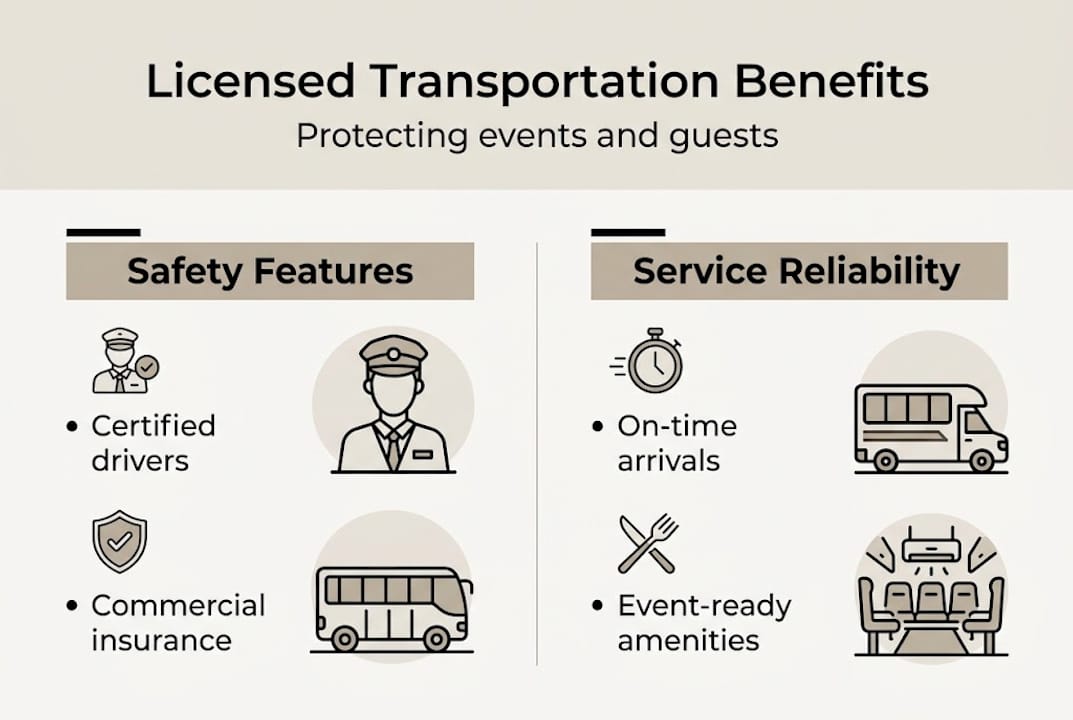
Here’s a direct comparison of what guests experience depending on which type of provider you choose:
| Factor | Licensed provider | Unlicensed operator |
|---|---|---|
| On-time arrival | Professionally managed | Unpredictable |
| Driver professionalism | Trained and vetted | Unknown |
| Vehicle condition | Inspected and maintained | Unverified |
| Insurance if injured | Covered | No coverage |
| Complaint resolution | CPUC oversight available | No recourse |
| Event amenities | Reliable and as advertised | No guarantee |
Protections you receive when booking a licensed provider:
- Commercial insurance that covers passengers in the event of an accident
- Drivers trained in professional conduct and event logistics
- Vehicles that meet state safety standards
- Legal accountability through CPUC if something goes wrong
- Contractual obligations the provider must fulfill
- Peace of mind for you and your guests throughout the event
For weddings in particular, transportation is part of the experience. An American Canyon chauffeur service or a Vacaville limo service that holds a valid TCP permit gives you confidence that your guests will arrive safely, on time, and in style. That’s not a luxury. That’s the baseline.
How to verify and book a licensed provider in Northern California
Knowing why licensing matters is one thing. Actually confirming a provider’s status before you book is another. Here’s a straightforward process to protect yourself.
Event planners are advised to verify CPUC and TCP status, insurance, and safety records to avoid risks before signing any transportation contract. Follow these steps:
- Ask for the TCP number. Any legitimate provider should give this to you immediately without hesitation.
- Verify using the CPUC tool. Use the CPUC verification tool to confirm the permit is active and in good standing.
- Request a certificate of insurance. Ask for a current certificate showing commercial liability coverage. Confirm the coverage amount matches the vehicle type.
- Review the driver’s record. Ask whether drivers are employees or contractors, and confirm background checks and drug testing are part of their standard process.
- Check for a physical address and fleet. Companies with actual offices and owned fleets are generally more accountable than solo operators.
- Read the contract carefully. Confirm cancellation policies, arrival times, and what happens if a vehicle breaks down.
Pro Tip: For booking group transportation during peak seasons like wedding season (May through October in Northern California), book at least 6 to 8 weeks in advance. Licensed providers with strong reputations fill up fast, and last-minute options often push planners toward unlicensed alternatives out of desperation.
Also ask for references from past events similar to yours. A provider who regularly handles corporate events or weddings will have a track record you can verify. Don’t skip this step just because the vehicle photos look impressive.
Why most event planners underestimate transportation risks
Here’s something we’ve observed working with event planners across Northern California: the biggest mistakes don’t come from ignorance. They come from misplaced confidence.
Many organizers assume that a polished online presence or a strong Google rating equals legal compliance. It doesn’t. A company can have hundreds of five-star reviews and still be operating without a TCP permit or adequate insurance. CPUC safety assurance enforcement data shows proactive oversight, but it also highlights how passenger liability and lack of accountability remain persistent risks with unlicensed operators.
The “cheapest option wins” mindset is genuinely dangerous in this industry. When something goes wrong with an unlicensed provider, the financial and legal exposure can dwarf whatever you saved on the booking. We’ve seen events where a single incident created liability questions that took months to resolve.
Seasoned planners learn to ask for legal proof, not just a business card or a website link. They request the TCP number, verify it independently, and review the insurance certificate before any deposit changes hands. That’s not paranoia. That’s professionalism.
True premium limo safety isn’t about the vehicle’s interior. It’s about what’s behind the scenes: the permits, the insurance, the trained drivers, and the regulatory accountability that protects everyone on board. Fancy leather seats mean nothing if the driver isn’t properly screened or the vehicle hasn’t been inspected.
Plan your event with licensed transportation you can trust
You’ve done the research. You understand what separates a safe, professional provider from a risky one. Now it’s time to put that knowledge to work for your next event.
At Party Bus Broker, every provider in our network holds the required TCP permits, carries commercial insurance, and employs vetted, professional drivers. We specialize in special event transportation for weddings, corporate events, wine tours, and celebrations throughout Northern California and beyond. Whether you need a single luxury vehicle or coordinated group shuttle services for hundreds of guests, we match you with the right licensed operator for your needs. Reach out today and let us handle the logistics so you can focus on the event itself.
Frequently asked questions
How can I check if a transportation provider is licensed in California?
Use the CPUC public search tool to verify a valid TCP number and active insurance for any event transportation provider. This takes less than five minutes and can save you from a serious liability situation.
What are the minimum insurance requirements for licensed charter vehicles?
Licensed event vehicles must carry commercial liability insurance ranging from $750,000 to $5 million, depending on vehicle size and type. Unlicensed operators carry none of this coverage, leaving passengers unprotected.
Are unlicensed transportation companies really a problem for events?
Yes. Unlicensed operations are actively cited, fined, and impounded by the CPUC in California, confirming they remain a real and ongoing risk for event planners who don’t verify provider credentials.
Is booking licensed group transportation more expensive than unlicensed?
Licensed providers may cost more upfront, but unlicensed operators expose passengers to breakdowns, unqualified drivers, and zero accountability. The true cost of an unlicensed provider can far exceed any initial savings.